

1. Introduction
In times of fluctuating stock markets and uncertain economic situations, many savers are looking for a secure way to invest their money. Savings accounts and fixed-term deposits are among the most popular forms of savings in Germany. Both investment options offer a high degree of security through statutory deposit insurance and relatively good predictability. However, they differ significantly in terms of flexibility, interest rates, and availability.
In this article, we explain in detail which of the two investment forms is suitable for which type of investor and how you can get the most out of your savings.
2. What is a Fixed-term Deposit?
2.1 Definition and Basic Principle
A fixed-term deposit is an investment where you deposit your capital for a predetermined period (e.g., 6 months, 1 year, or 3 years) at a fixed interest rate. This means that you have no access to the money for the entire duration of your investment, or can only access your capital under certain conditions (often with a loss of interest).
Important Features
- Fixed term (usually 1 month to 5 years)
- Fixed interest rate for the entire investment period
- Generally no early termination possible without losses
- Statutory deposit insurance up to 100,000 euros per bank and customer
2.2 Advantages of Fixed-term Deposits
- Planning security: The interest rate is guaranteed for the entire term.
- Higher interest rates than savings accounts: Since the bank can plan with your money over a defined period, you usually receive a higher interest rate than with a savings account.
- High security: The invested capital is protected up to 100,000 euros through deposit insurance.
2.3 Disadvantages of Fixed-term Deposits
- Low flexibility: During the term, you have no or only limited access to your money.
- Interest rate change risk: If market interest rates rise during your term, you cannot benefit from the better conditions.
- Possible real value loss due to inflation: If the inflation rate is higher than your interest rate, your money loses real purchasing power.
3. What is a Savings Account?
3.1 Definition and Basic Principle
A savings account is a variable interest-bearing account that you can access at any time. However, the bank can adjust the interest rate whenever it wants. Savings accounts are particularly suitable for short-term reserves or as an emergency fund that needs to be quickly available.
Important Features
- No fixed term: Your money is available at any time
- Variable interest rate: The interest can change up or down
- Statutory deposit insurance up to 100,000 euros per bank and customer
3.2 Advantages of Savings Accounts
- High flexibility: You can withdraw or deposit your money at any time.
- Security: The statutory deposit insurance up to 100,000 euros also applies here.
- No minimum deposit: Banks often offer savings accounts without minimum or maximum deposit amounts.
3.3 Disadvantages of Savings Accounts
- Interest rate instability: As the interest rate is variable, it can be lowered at any time.
- Typically lower interest rates: Compared to fixed-term deposits, the interest rate is usually lower because the bank has no long-term planning security.
- Promotional offers are time-limited: Many banks advertise high introductory interest rates for new customers but lower these after a certain period.
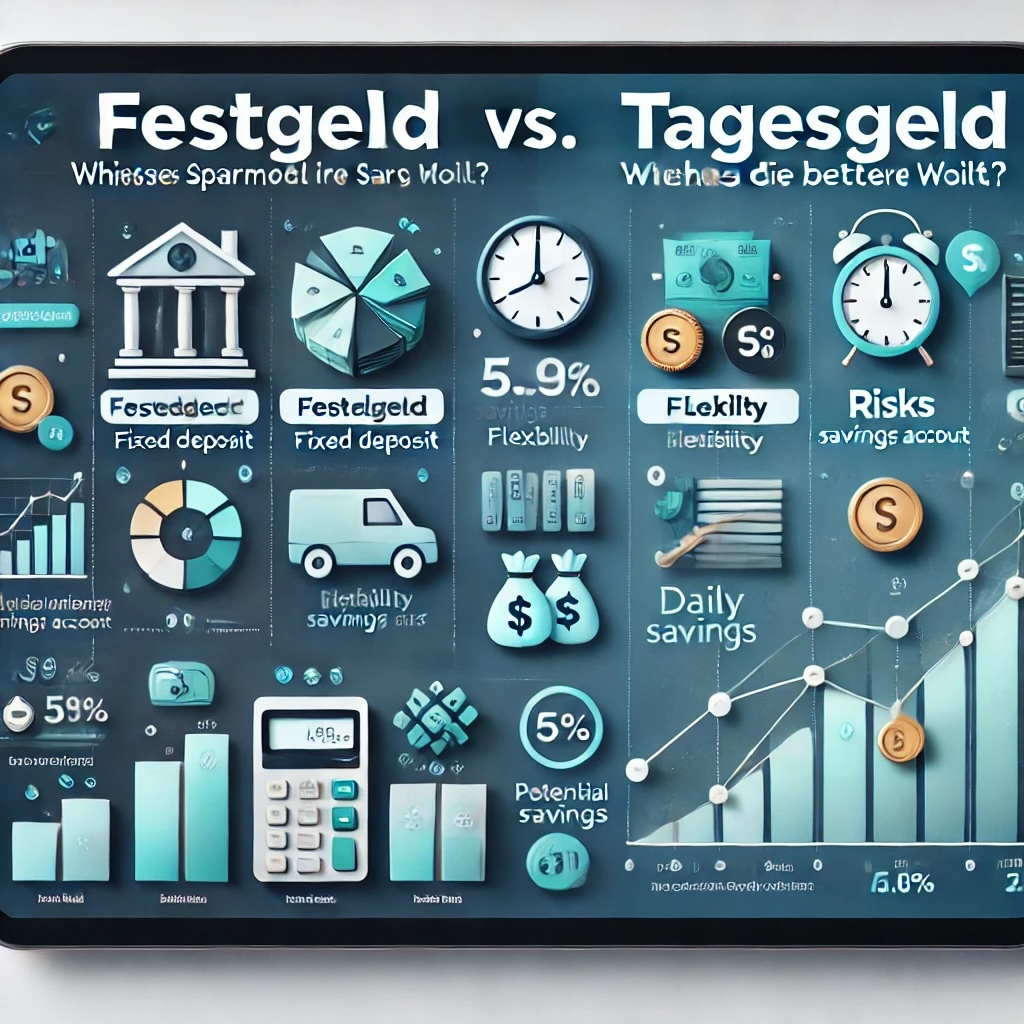
4. Direct Comparison: Fixed-term Deposit vs. Savings Account
To better illustrate the differences between fixed-term deposits and savings accounts, let’s look at the most important criteria side by side:
| Criterion | Fixed-term Deposit | Savings Account |
|---|---|---|
| Interest rate | Usually higher, but fixed for the entire term | Variable, can fluctuate; often lower than fixed-term deposits |
| Availability | Capital tied up for the term | Available at any time, without notice period |
| Flexibility | Low (withdrawal before maturity only with losses) | Very high (money can be withdrawn at any time) |
| Term | Fixed defined period (e.g., 3, 12, or 24 months) | No fixed term |
| Interest Rate Changes | No adjustment during the term, even if interest rates rise | Interest rate can increase or decrease at any time |
| Suitability | Long-term planning, higher interest rates, no short-term need | Short-term liquidity reserve, emergency fund, savings account as a “parking space” |
5. Which Model is Suitable for which Type of Investor?
- Fixed-term Deposit: Ideal for investors who already have a well-funded emergency reserve and want to plan securely in the medium term. They want to invest their money for a fixed period and receive an attractive, stable interest rate in return.
- Savings Account: Perfect for those who need a short-term money reserve. Whether for unforeseen expenses, a planned project, or as a transitional solution when reallocating other investments: The savings account always gives you access to your capital.
6. Current Interest Rate Situation: are both Forms of Savings Still Worthwhile?
The interest rate landscape in Europe is changing. After a long period of low interest rates, rates are slowly rising – both for fixed-term deposits and savings accounts. In general:
- Fixed-term deposit interest rates are rising moderately, especially for longer terms.
- Savings account interest rates are still relatively low, but can be more attractive temporarily as part of special promotions.
Conclusion: Yes, both forms of savings can be worthwhile – but with different focuses. While fixed-term deposits promise stable returns, savings accounts score with permanent availability.
7. Advantages and Disadvantages in Practice
7.1 Practical Example: Fixed-term Deposit
- Example: You invest 10,000 euros for 2 years at a fixed interest rate of 2.0% p.a.
- Result: At the end of the term, you have an interest income of 200 euros per year (plus compound interest if the bank makes annual credits).
- Risk: If market interest rates rise sharply during these 2 years, you have no opportunity to invest at a higher rate.
7.2 Practical Example: Savings Account
- Example: You park your emergency fund of 5,000 euros in a savings account that currently offers 1.0% p.a. interest.
- Result: You can access the money at any time if needed. If the washing machine suddenly breaks down, you have capital available immediately.
- Risk: If the bank lowers the interest rate at short notice, your return will also decrease.
8. Combination Strategy: the Best of both Worlds
Many financial experts recommend a combination of fixed-term deposits and savings accounts:
- Emergency fund in savings account: Keep a certain amount (e.g., three to six monthly salaries) always available for unforeseen expenses.
- Excess capital in fixed-term deposits: Invest the amount you don’t need in the medium term at a fixed interest rate to achieve a higher return.
With this strategy, you benefit from both the security and stable returns of fixed-term deposits and the flexibility of savings accounts.
9. Tips for Choosing the Right Provider
- Use comparison portals: Check current interest offers and read reviews of various banks.
- Check deposit protection: Make sure the bank is connected to the EU-wide deposit protection scheme (usually 100,000 euros per person and bank).
- Consider additional services: Some banks offer new customer bonuses, starting credit, or other extras.
- Interest crediting: Especially with fixed-term deposits, annual interest crediting can create a compound interest effect.
- Term staggering for fixed-term deposits: Divide your investment into different terms to be able to react flexibly to interest rate changes.
10. Frequently Asked Questions (FAQ)
1. Can I Terminate a Fixed-term Deposit Account Early?
Generally, this is not possible, or it leads to significant interest losses. Check the terms and conditions in your bank’s general terms and conditions.
2. Is a savings account worthwhile with rising inflation?
Savings accounts can lose real purchasing power during high inflation. Nevertheless, they offer the advantage of being available at any time. Those who want to secure capital preservation over a longer period should look for higher returns or check inflation-protected forms of investment.
3. What risks exist with fixed-term deposits and savings accounts?
Thanks to deposit insurance, both forms of investment are very safe. The main ‘risk’ is a possible loss of purchasing power due to inflation or, in the case of fixed-term deposits, the missed opportunity to benefit from rising interest rates.
4. Can I maintain multiple savings accounts or fixed-term deposit accounts in parallel?
Yes, this is possible and sometimes even sensible. By having multiple accounts at different banks, you can pursue certain investment strategies or benefit from various promotions.
5. How do I find the best offer?
Use comparison portals, pay attention to current interest rate developments, and look at customer reviews. Also, pay attention to possible special conditions, bonus promotions, or minimum deposit amounts.
11. Conclusion
The question “Fixed-term deposit vs. savings account: Which savings model is the better choice?” cannot be answered universally with “Either or”. Both forms of investment have their justification and address different needs:
- Fixed-term deposits score with higher interest rates and planning security, but are less flexible.
- Savings accounts offer availability at any time and variable interest rates, which can also decrease.
For many savers, a combination of both savings models is optimal: Part of the money is parked flexibly in the savings account, while the larger (or long-term dispensable) part earns higher interest in a fixed-term deposit account.
Before you decide, analyze your personal financial situation, your liquidity needs, and your investment goal. This way, you’ll find the perfect balance between security, flexibility, and return.